
sub-029.94 hours
24 sessions · 120 runs
A deep fMRI dataset for decoding naturalistic speech in the human brain
Mesh adapted from “Human head” by ADAMA, CC BY 4.0
participants
hours per participant
hours of unique stimuli
fMRI volumes
01Dataset
Three participants each spent 24 sessions in the scanner, five runs per session, listening to French podcast episodes: unscripted stories in which people open up about their lives, their relationships and what they feel. Play an excerpt below to follow the words and the brain activity they evoked.
Et il y a 3 maisons. Les plus petits ont la leur, il y en a une autre pour les ados à partir de 15 ans et la troisième est la plus importante.
And there are three houses. The youngest children have their own; there is another for teenagers aged fifteen and over, and the third is the most important.
The dataset lives on Hugging Face and the baseline on GitHub. Stream the data straight into Python with the datasets library: the snippet below loads one participant’s training split on the fsaverage5 surface, without downloading everything first. Or hand the prompt to your coding agent and let it set up the baseline decoder for you.
Load the data
from datasets import load_dataset

ds = load_dataset(
    "karavela/cephalonauts_one",
    name="sub-1_fsaverage5",
    split="train",
    streaming=True,
)Ask your agent
Read the Cephalonauts One paper [1] and explore the Cephalonauts One dataset [2]. Let’s get set up to train the baseline decoder, then try to beat it! [1] https:// arxiv.org/ abs/ 2610.03558 [2] https:/ / huggingface.co/ datasets/ karavela/ cephalonauts_one
Each of the three participants spent about 30 hours in the scanner over 24 sessions, listening to French podcasts: 90 hours of whole-brain fMRI across 358 runs. Every participant’s sessions are split the same way, with 22 for training, one for validation and one held out for testing.
3T whole-brain recordings in volume space and on the cortical surface.
The podcast episodes, exactly as heard in the scanner.
French text, time-aligned word by word to the brain recordings.
Audio and text features time-aligned to the scans.
Each block is one session. The test session rotates across folds.
02Benchmark
The benchmark asks a model to recover what a participant heard from their brain recordings alone. Each chunk of speech Z is played to the participant, giving pre-processed fMRI recordings X, and is also passed through a pre-trained audio or text encoder, giving stimulus embeddings Y. A decoder fθ learns to predict Y from X.
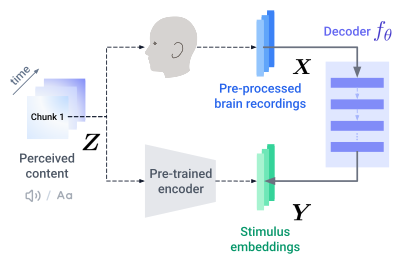
To evaluate the decoder, each of its predictions on held-out sessions is compared with the embeddings of 2,000 candidate speech segments, which are ranked by similarity. Decoding counts as correct when the segment the participant actually heard ranks among the 10 closest: the top-10@2000 accuracy reported below.
See Methods in the paperWe trained the decoder on 1 to 30 hours of each participant’s recordings and scored it this way on held-out sessions. For all three participants, decoding keeps improving as the training data grows across the measured range.
See Methods in the paperHow often the correct segment ranks among the model’s top 10 of 2,000 candidates. Higher is better.
Lines: mean across 5 folds · Bands: ±1 SD · fsaverage5
@inproceedings{collas2026cephalonauts, title = {{Cephalonauts One}: A deep {fMRI} dataset for decoding naturalistic speech in the human brain}, author = {Collas, Antoine and Jalouzot, Louis and Ilinca, G{\'e}raud and Caris, Corentin and Valabr{\`e}gue, Romain and Hassayoune, Ahmed and Goncalves, David and Hueber, Madeleine and Delebarre, Thadd{\'e}e and Savatovsky, Julien and Fonteneau, Clara and Maussion, Charles and Thirion, Bertrand and Thual, Alexis}, booktitle = {Advances in Neural Information Processing Systems (NeurIPS), Track on Evaluations and Datasets}, year = {2026}, eprint = {2610.03558}, archivePrefix = {arXiv}, url = {https://arxiv.org/abs/2610.03558}}
We’re recruiting healthy volunteers for Cephalonauts One, our ongoing brain MRI study. Join the waitlist to spend a few sessions in the scanner, learn more about your own brain and help build the kind of data that brain research is still missing.